FOOD TOUR WITH PAOLO
di Matteucci Paolo
Via donatori di sangue, 56
Modena - CAP 41126
P.I. 01726780503
FOLLOW US
Acetaia Visit in Modena: How Traditional Balsamic Vinegar Is Made and How to Taste It Properly
A visit to an acetaia in Modena is one of the best ways to understand what makes Traditional Balsamic Vinegar so unique.
For visitors discovering it for the first time, the name itself offers an interesting clue.
Why is it called “Balsamic”?
The Italian word balsamico is related to the idea of a balsam — something soothing or beneficial.
This is not simply a poetic association.
Throughout its long history, balsamic vinegar was also regarded as a remedy and was traditionally used in various ways: to soothe a cough, relieve a sore throat or help with nausea.
Whether or not we would describe it as a medicine today, the historical connection explains something important about this extraordinary product.
Traditional Balsamic Vinegar was never simply considered an ordinary vinegar.
And it should not be confused with common wine vinegar.
How Traditional Balsamic Vinegar is made
One of the most fascinating things you discover during an acetaia visit is how different the production process is from that of ordinary vinegar.
Traditional Balsamic Vinegar of Modena begins with the cooked must of local grapes.
The freshly pressed grape must is slowly cooked and then transformed through a long aging process.
But the story does not end there.
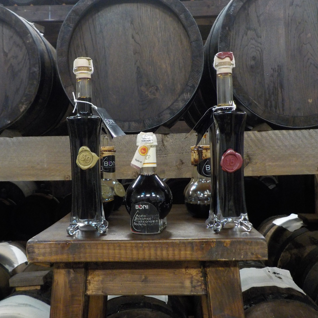
The cooked must is placed in a series of small wooden barrels, traditionally made from different types of wood. Over time, the vinegar develops its characteristic concentration, aroma, complexity and texture.
The wood is not simply a container.
Different woods contribute to the character of the product, while the gradual aging process concentrates the flavors and creates the extraordinary balance between sweetness and acidity that distinguishes Traditional Balsamic Vinegar.
This is one of the reasons why seeing an authentic batteria of barrels inside an acetaia can be so revealing.
You are not simply looking at vinegar being stored.
You are looking at a process that depends on time, craftsmanship, wood and patience.
What is the difference between balsamic vinegar and ordinary vinegar?
This is one of the most common questions visitors ask.
Ordinary wine vinegar is produced from wine through a process of acidification. Traditional Balsamic Vinegar of Modena follows a completely different path, beginning with grape must that is cooked and then aged for many years.
The result is different in appearance, aroma, texture and taste.
Traditional Balsamic Vinegar is intensely aromatic and concentrated, with a characteristic balance of sweetness and acidity.
And because it is so concentrated, you do not use it in the same way you might use a common vinegar.
How should you taste Traditional Balsamic Vinegar?
Tasting it properly is part of the experience.
At an authentic acetaia, you have the opportunity to appreciate the vinegar not simply as a condiment, but as a product with its own aromas, texture and complexity.
Start with a small quantity.
Observe its appearance and consistency. Then smell it before tasting it. Finally, allow a small drop to move across your palate.
Pay attention to the balance between acidity and sweetness, its aromatic intensity and the persistence of its flavor.
The experience changes considerably when you taste it alongside food.
And this is where visitors often discover something unexpected.
Unexpected ways to enjoy Balsamic Vinegar
Many people arrive in Modena thinking of balsamic vinegar only as something to put on a salad.
Traditional Balsamic Vinegar can be much more versatile.
Depending on its characteristics and age, it can be paired with foods in ways that may initially seem surprising.
It can accompany Parmigiano Reggiano, for example, creating a remarkable contrast between the savory character of the cheese and the sweetness and acidity of the vinegar.
But some of the most memorable combinations are even less obvious.
This is one of the reasons why tasting Traditional Balsamic Vinegar at its source is so different from simply buying a bottle in a supermarket.
You discover not only how it is made, but also how it was traditionally meant to be experienced.
Why visit an acetaia in Modena?
Reading about Traditional Balsamic Vinegar can tell you the basic facts.
Visiting an authentic acetaia allows you to understand them with all your senses.
You can see the wooden barrels, smell the aging vinegar, learn about the grapes and production process, and taste the finished product.
Most importantly, you can ask questions and understand the difference between a traditional product and the many products sold under the generic name “balsamic vinegar.”
For a first-time visitor to Modena, an acetaia visit is therefore much more than a tasting.
It is an introduction to one of the most fascinating food traditions of Emilia-Romagna — a tradition in which grape must, wood and time come together to create something extraordinarily concentrated and complex.
And once you have tasted authentic Traditional Balsamic Vinegar in Modena, you may never look at a bottle of “balsamic vinegar” in quite the same way again.