FOOD TOUR WITH PAOLO
di Matteucci Paolo
Via donatori di sangue, 56
Modena - CAP 41126
P.I. 01726780503
FOLLOW US
The Best Food Experiences in Modena, Italy: Parmigiano Reggiano, Balsamic Vinegar and Local Traditions
When people think about Italian food, they often think about pizza, pasta, gelato and wine.
But if you come to Modena, in the heart of Emilia-Romagna, there are two extraordinary products that deserve your full attention:
Parmigiano Reggiano and Traditional Balsamic Vinegar of Modena.
They are very different products, but they share something important.
Both are the result of a remarkable combination of simple ingredients, traditional methods, human skill and time.
And the best way to understand them is not simply to taste them in a restaurant. It is to visit the producers and see how they are made.
Parmigiano Reggiano: an extraordinary food born from simple ingredients
Parmigiano Reggiano is often described as one of Italy's great superfoods.
Its nutritional profile certainly helps explain its reputation. It is naturally rich in protein and develops an intense concentration of flavor as it ages.
But perhaps the most fascinating thing about Parmigiano Reggiano is how little is needed to make it.
The production starts with raw cow's milk. The cows are raised according to the strict regulations of the Parmigiano Reggiano production system, with their diet based on forage and hay produced within the designated area.
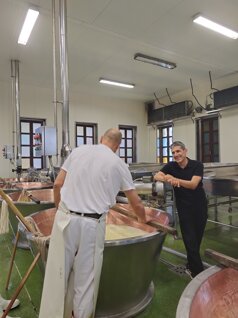
The milk is delivered to the dairy and processed every day.
From there, a traditional sequence begins.
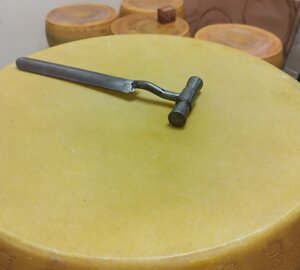
The curd is formed, the cheese is divided and shaped into its characteristic wheels, and the wheels are placed in a salt-water brine before beginning their long maturation.
Nothing about the process is rushed.
In fact, the minimum maturation period for Parmigiano Reggiano is 12 months, but many wheels are aged considerably longer.
This tradition has extraordinarily deep roots. The production of this type of cheese dates back approximately nine centuries, with techniques developed in medieval monasteries in the area.
What those early producers discovered was that milk could be transformed into a cheese capable of being preserved for a very long time while developing an extraordinary concentration of flavor.
Today, the result is one of the most recognizable cheeses in the world.
Traditional Balsamic Vinegar: the Modena tradition in a bottle
If Parmigiano Reggiano represents an extraordinary cheese tradition, Traditional Balsamic Vinegar of Modena represents one of the most fascinating food traditions of Modena itself.
Its production is based on a surprisingly simple starting point: grape must.
The must is cooked and then allowed to undergo a natural process of fermentation and acetification.
The transformation is not achieved by adding a long list of ingredients.
Instead, microorganisms naturally involved in the process, together with the producer's knowledge and attention, gradually transform the cooked grape must.
Then comes the most important ingredient of all: time.
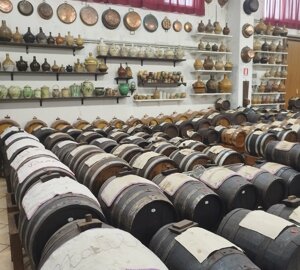
The product is transferred repeatedly between wooden barrels as it ages. Different types of wood can be used, and each barrel becomes part of a long process that the producer carefully observes and guides.
The vinegar becomes progressively more concentrated and develops an extraordinary combination of aromas, acidity, sweetness and texture.
It is a remarkable example of how a product made from something as simple as grapes can become incredibly complex.
The human element
Neither Parmigiano Reggiano nor Traditional Balsamic Vinegar can be understood simply by reading a recipe.
The producer plays a fundamental role.
In a dairy, experience is essential to understanding the milk and managing the different stages of cheese production.
In an acetaia, the producer follows the evolution of the vinegar over the years, managing the transfers between barrels and understanding how the product changes with time.
This is why visiting an authentic producer can be such a powerful food experience.
You don't just see the finished product.
You see the process behind it.
Two products, one extraordinary pairing
Once you understand these two products individually, there is an obvious — and delicious — way to experience them together.
Parmigiano Reggiano with Traditional Balsamic Vinegar.
The intense, savory and slightly granular character of aged Parmigiano Reggiano works beautifully with the concentrated sweetness and acidity of Traditional Balsamic Vinegar.
It is a simple combination, but it is deeply connected to the territory.
And it illustrates something that is fundamental to Italian food culture: you don't necessarily need complicated recipes when the ingredients themselves have extraordinary character.
Sometimes, two exceptional ingredients are enough.
Why a local food experience makes a difference
You can taste Parmigiano Reggiano and balsamic vinegar almost anywhere.
But tasting them in Modena, after visiting the places where they are produced, is a completely different experience.
You learn where the products come from.
You discover how they are made.
You meet the people who dedicate their work to maintaining these traditions.
And then, when you taste the products, you have a completely different understanding of what is on your plate.
This is what makes a food experience in Modena so special.
It is not only about eating.
It is about connecting the food with its territory, its history and the people who continue to produce it.
Discover the food traditions of Modena
For visitors coming to Modena for the first time, a tour that combines Parmigiano Reggiano and Traditional Balsamic Vinegar offers an extraordinary introduction to the local food culture.
Two products.
Two production methods.
Two traditions that have developed over centuries.
And one territory that has learned how to turn remarkably simple ingredients into foods of extraordinary complexity.
If you want to discover the real food traditions of Modena, don't stop at tasting the finished products.
Go to the source. See how they are made. Meet the producers. And then taste them with a completely different perspective.
That is when a food tour becomes much more than a meal — it becomes a genuine experience of Modena.